Cold in-place recycling & stabilization
The old pavement becomes the new base. We pulverize the existing road, blend in cement or bitumen emulsion, and compact it in a single pass. Faster and cheaper than full reconstruction, with far less new material hauled in.
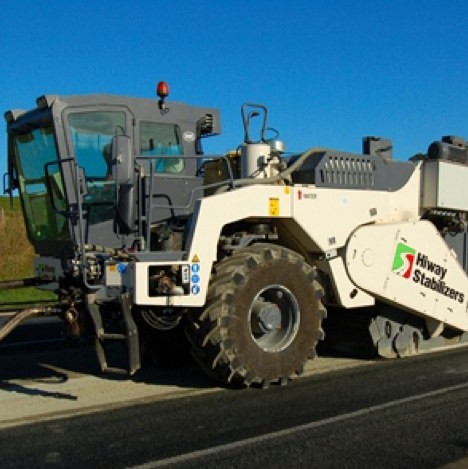
Four passes, one new base.
The WR2000 mills the old asphalt and base to the design depth and grades the material in place.
Cement is spread ahead at the lab-designed rate, or emulsion is injected directly into the mixing chamber.
A second pass homogenizes the layer; the grader restores crossfall and line.
20-tonne compaction to target density, verified by our laboratory before the wearing course goes on.
Regional roads with a failed base and a sound alignment.
Cold recycling is the right answer when the pavement is cracked through but the road line, drainage and width are fine. The existing material is reused, so there is no haul-off, no quarry run, and the road reopens in days rather than weeks.
Since 2014 Georgian Construction Group has been the leading provider of base-building works by cold recycling and stabilization in Georgia, on roads of national and regional importance.
- Poilichala, Tbilisi–Rustavi
- Tbilisi bypass
- David-Gareji road
- Akhalkalaki–Bakuriani
- Lagodekhi
How deep can you recycle?
The Wirtgen WR2000 works the pavement to the design depth, typically 20 to 30 cm, pulverizing the old asphalt and base together so the recycled layer becomes a homogeneous new base.
Cement or emulsion: which binder?
It depends on the material and the traffic. Cement gives a stiff, strong base; bitumen emulsion gives a more flexible one. Our laboratory designs the mix (groups III and V) and sets the binder rate before the machine arrives.
How long until traffic can return?
Compaction is completed the same day and the recycled base can usually carry site traffic within 24 hours; the wearing course follows after the laboratory confirms density and strength.